
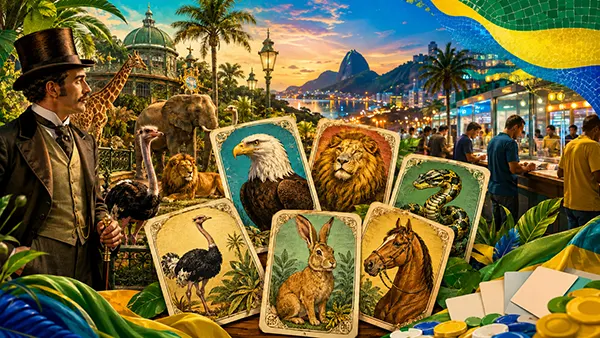
Few gambling traditions reflect Brazil’s social and legal history as clearly as Jogo do Bicho. What began in Rio de Janeiro in 1892 as an attraction designed to bring visitors to a struggling zoological garden developed into an informal lottery recognised across the country. Its simple animal symbols, small-stake bets and neighbourhood sales network helped it survive repeated attempts at prohibition, while its long association with informal commerce, political influence and organised criminal groups made its history far more complicated than that of an ordinary lottery. Brazil entered a very different betting environment in the 2020s, introducing federal rules for fixed-odds sports betting and online games. Yet by 2026 Jogo do Bicho itself remained prohibited. This distinction is central to understanding its modern position: Brazil now has a closely supervised legal betting sector operating beside an animal lottery whose possible legalisation is still being debated more than 130 years after its creation.
How a Rio Zoo Raffle Became Jogo do Bicho
The origins of Jogo do Bicho can be traced to the Jardim Zoológico in Vila Isabel, Rio de Janeiro. The zoo had been established by businessman João Batista Viana Drummond, later known as the Baron of Drummond, and was experiencing financial difficulties after losing public support that had helped sustain it. In 1892 Drummond introduced a simple attraction connected with admission tickets. Visitors received an image of an animal when entering the zoo, while the picture of one of 25 animals was concealed inside a wooden box displayed near the entrance. At the end of the day the hidden animal was revealed. Visitors holding the corresponding image received a prize worth 20 times the admission price. Contemporary newspaper evidence places the first animal draws in early July 1892.
The idea succeeded because it was easy to understand and required no specialised knowledge. The animal images also made the game accessible to a broad public at a time when literacy levels varied considerably. Demand soon moved beyond the physical boundaries of the zoo. Intermediaries began taking bets in streets, cafés, shops and other busy parts of Rio, allowing people to participate without buying zoo admission. The original attraction therefore changed remarkably quickly from a promotional raffle into an independent form of popular gambling. A recognisable numerical structure developed around the animals, eventually producing the familiar system of 25 groups covering 100 two-digit endings. Each animal became associated with four numbers, creating a practical link between visual symbols and numerical betting.
Authorities reacted almost as quickly as the public embraced the game. The activity had initially operated with municipal permission, but police and officials increasingly regarded the expanding street trade as gambling rather than a simple zoo promotion. In 1895 the mayor of the Federal District prohibited the animal draw at the zoological garden. The decision ended the short legal phase of Drummond’s original scheme, but by then the idea had already escaped the institution that created it. Sellers had customers, established locations and a system that could function without animals, cages or zoo tickets. Prohibition therefore changed where and how Jogo do Bicho operated rather than bringing the practice to an end.
From Street Sellers to a National Informal Network
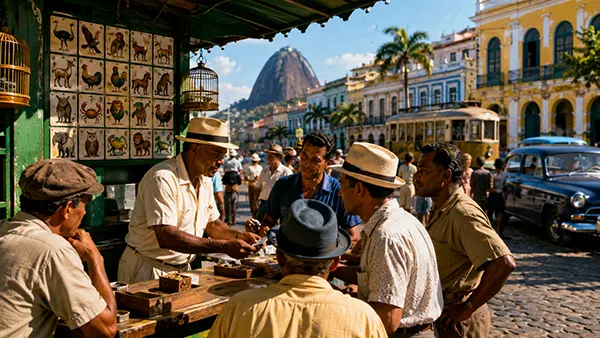
During the early decades of the twentieth century, Jogo do Bicho became part of Rio’s everyday informal economy. Bettors could place relatively small amounts with local sellers commonly known as apontadores or cambistas, while larger figures responsible for financing and settling bets became known as bicheiros or banqueiros. The arrangement relied heavily on personal relationships and reputation because customers were dealing with an activity outside formal consumer protection. A winning ticket had value only if the organisation accepting the bet honoured it. This reliance on repeated local transactions helped establish long-lasting neighbourhood networks and gave the game a level of continuity that occasional police action rarely eliminated.
The numerical system also encouraged repetition. The traditional table contains 25 animals, each connected to four numbers, producing 100 endings from 01 through 00. Bets could be made on animals, groups or different numerical combinations, while local operators used published results to settle wagers. The details developed over time and could vary between regions, but the underlying model remained familiar enough to travel easily. By the middle of the twentieth century Jogo do Bicho had spread far beyond Rio de Janeiro. Research on organised illegal markets in Brazil indicates that it was present across the country by the 1950s, although there was no single national organisation controlling every local operation.
That decentralisation is important when describing the game accurately. Jogo do Bicho was never simply one business spreading from Rio under a single chain of command. Different cities and states developed their own bankers, territories and commercial arrangements. In Rio, competition for profitable areas became particularly significant. Academic research has linked disputes between major bankers during parts of the twentieth century to violence and territorial control. The familiar image of a neighbourhood seller taking small bets therefore represented only the most visible end of a much larger informal economy. The history of Jogo do Bicho includes ordinary customers and street commerce, but it also includes corruption allegations, conflicts between powerful operators and recurring attempts by authorities to weaken organisations controlling the trade.
Why Jogo do Bicho Survived Decades of Prohibition
The legal position became clearer at federal level with Brazil’s Penal Contraventions Law of 1941. Article 58 specifically prohibited operating or conducting the lottery known as Jogo do Bicho and acts connected with its operation. This classification as a contravention became one of the defining features of the game’s history. It was prohibited throughout the country, yet enforcement was uneven and the activity remained highly visible in many places. The gap between the written law and everyday practice produced an unusual situation in which generations of Brazilians could recognise the animals, understand the basic betting system or know where bets were taken even though no ordinary commercial licence existed for the activity.
Several practical factors help explain that persistence. A traditional Jogo do Bicho operation required little infrastructure compared with a large gambling venue. A seller needed a means of recording bets, transmitting them and later confirming results. Small neighbourhood points could close, relocate or change personnel without destroying the wider network. The game was also based on familiar rules and could accept modest wagers, giving it a different social profile from expensive forms of gambling. Trust often developed between customers and particular sellers over years. These characteristics did not make the activity lawful, but they made complete suppression difficult because enforcement against one betting point did not remove the demand or the organisations behind other points.
Competition also changed the business. State lotteries expanded, new legal lottery products became available and later generations gained access to sports betting and internet-based gambling. Academic research records a significant reorganisation among major Rio bankers around 1980, when leading figures reached an arrangement that reduced some of the conflicts that had characterised earlier competition. The same period brought diversification into other businesses. Jogo do Bicho consequently became one part of a broader economic structure for some influential operators rather than their only source of income. By the twenty-first century its cultural recognition remained considerable, but it was competing for customers with official lotteries, sports betting and other forms of gambling that offered faster and more varied ways to place a wager.
The Cultural Weight and the Risks Behind the Familiar Image
The game’s endurance cannot be explained by economics alone. Its animal table entered Brazilian popular culture and became connected with everyday expressions, dreams, superstitions and informal number choices. Historical research has also examined its relationship with football, carnival, popular music and neighbourhood life. These connections helped turn the animal symbols into references understood by people who did not necessarily bet. The contrast is striking: an activity prohibited for most of its existence became highly recognisable in ordinary social life. That cultural familiarity partly explains why public attitudes towards Jogo do Bicho have often been more complicated than the straightforward legal distinction between permitted and prohibited gambling would suggest.
Rio’s carnival provides one of the most visible examples of this complicated history. Prominent figures associated with Jogo do Bicho became connected with samba schools through financing, organisation and local patronage, particularly during the second half of the twentieth century. Such relationships contributed money to cultural organisations but also increased the political and social influence of powerful gambling groups. It would therefore be misleading either to describe Jogo do Bicho only as harmless folklore or to reduce its entire history to organised crime. The same activity could involve a low-value street wager at one level and significant territorial, financial and political interests at another. Both parts belong to the historical record.
The illegal structure also creates risks that regulated gambling rules are designed to reduce. An informal bettor has no equivalent of a federally supervised complaint process, formal technical standards or clearly defined requirements for protecting customer funds. Operators outside legal supervision may also make financial flows harder for authorities to trace. In Rio, studies of criminal networks have documented links between parts of the Jogo do Bicho economy and violence, corruption and territorial disputes. These facts matter when discussing legalisation. The policy question is not simply whether an old Brazilian tradition should be permitted. It is also whether moving an existing underground activity into a licensed system could improve financial transparency and oversight, and whether regulation could actually separate lawful businesses from criminal structures built during decades of prohibition.
Brazil’s Regulated Betting Era and the Status of Jogo do Bicho in 2026
Brazil’s gambling landscape changed substantially long before lawmakers reached agreement on Jogo do Bicho. Federal Law No. 13,756 of 2018 created the legal basis for fixed-odds sports betting, while Law No. 14,790 of 2023 established a much more detailed framework and included online gaming events within the fixed-odds regime. The practical transition occurred during 2024 and 2025 as the Ministry of Finance and its Secretariat of Prizes and Betting, known as SPA, issued operational rules and processed authorisation applications. From 1 January 2025, companies offering federally authorised fixed-odds betting nationally were required to hold SPA authorisation. Their authorised betting sites use the .bet.br domain, providing consumers with a simple way to distinguish the federally regulated market from unauthorised sites.
The new system introduced controls very different from the informal model historically associated with Jogo do Bicho. Authorised companies must be established under Brazilian law and comply with requirements covering customer identification, financial integrity, responsible gambling, advertising and prevention of money laundering. Brazilian legislation also requires identification procedures that include facial recognition for bettors. Operators are subject to administrative supervision, and rules restrict advertising aimed at minors or communications that make unsupported claims about the likelihood of winning. These measures do not eliminate gambling-related harm, but they create identifiable legal responsibilities for companies and give authorities tools that are unavailable when betting is conducted through an unlicensed local network.
Enforcement against unauthorised fixed-odds betting also became stronger in 2026. Law No. 15,358 of March 2026 added provisions allowing financial accounts belonging to irregular fixed-odds operators to be blocked, while Decree No. 13,033 of 19 June 2026 set out procedures for those measures. This development illustrates the direction of Brazilian betting policy: legal gambling is increasingly tied to authorisation, identifiable operators, financial controls and active supervision. It is important, however, not to apply those changes automatically to every form of gambling. The legislation regulating fixed-odds betting did not repeal Article 58 of the Penal Contraventions Law. As of August 2026, traditional Jogo do Bicho therefore remained outside the federal authorised betting regime.
What PL 2,234/2022 Could Change — and What It Has Not Changed Yet
The principal legislative proposal that could alter this position is Bill PL 2,234/2022. The proposal covers a much wider range of gambling than the fixed-odds legislation and would create rules for activities including casinos, bingo and Jogo do Bicho. Its central idea is to replace prohibition with controlled legal operation subject to government supervision, licensing requirements, taxation and measures intended to address money laundering and gambling-related harm. For Jogo do Bicho, such a law would represent a fundamental change. Instead of operating as a prohibited lottery tolerated to varying degrees in different parts of the country, authorised businesses would have to enter a formal regulatory structure and comply with conditions established by the state.
The proposal has advanced considerably but has not completed the legislative process. The Senate’s Constitution and Justice Committee approved the legalisation proposal in June 2024 by 14 votes to 12. The bill was subsequently prepared for consideration by the full Senate, and its official record has listed it as ready for a plenary decision since July 2025. In December 2025 senators approved an urgency request for the proposal, increasing its procedural priority. Even so, the official Senate record on 9 August 2026 continued to classify PL 2,234/2022 as being in progress rather than enacted law. No federal licence created by that proposal was therefore available for traditional Jogo do Bicho operators at that date.
The position in 2026 is consequently more nuanced than saying that Brazil has either legalised or prohibited gambling as a whole. The country now has a functioning federal system for authorised fixed-odds sports betting and online games, accompanied by stronger identification, financial and enforcement requirements. At the same time, Jogo do Bicho remains governed by a prohibition whose roots stretch back to the nineteenth century and whose federal legal basis dates from 1941. PL 2,234/2022 could finally move the animal lottery from an informal economy into a regulated legal sector, but that change depends on legislation that has not yet taken effect. More than 130 years after a wooden box containing an animal image attracted visitors to a Rio zoo, the game remains both a piece of Brazilian social history and an unresolved question of modern gambling law.