
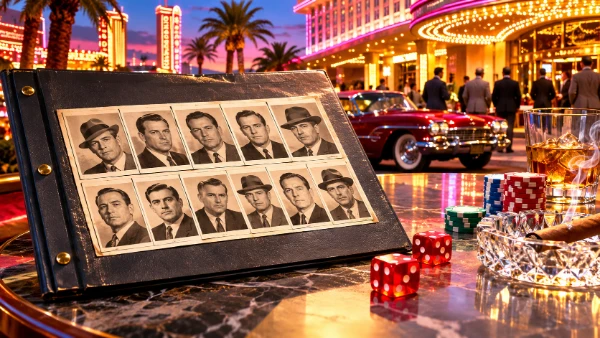
On 29 March 1960, Nevada gambling regulators circulated a small black-covered booklet containing photographs and personal details of 11 men who were no longer welcome in the state’s licensed casinos. The publication became known as the Nevada Black Book, an exclusion list created to restrict the influence of organised crime on legal gambling. Its introduction followed years of concern about criminal connections to Las Vegas resorts and growing pressure for stronger supervision. The original document was remarkably simple, but its consequences were substantial: casino operators risked their licences if they continued accommodating the named individuals. The decision also raised difficult questions about personal rights, evidence and the government’s authority to exclude people without criminal convictions directly related to casino operations.
Why Nevada Created the Casino Black Book in 1960
Nevada legalised casino gambling in 1931, becoming the only American state where such businesses could operate openly on a broad commercial scale for much of the following three decades. Las Vegas grew rapidly after the Second World War, attracting tourists, entertainers and investors. Major resorts, including the Flamingo, Desert Inn, Sands and Stardust, helped transform the city into a nationally recognised destination. Yet some of the money and individuals associated with this expansion also attracted the attention of federal investigators. Organised crime figures maintained relationships with casino owners, managers and influential guests, creating serious concerns about who actually benefited from the industry.
By the late 1950s, Nevada’s economic dependence on gambling made these connections particularly sensitive. Revenue from the industry had become essential to the state’s finances, while reports about organised crime threatened its public reputation. Federal investigations and congressional hearings had exposed criminal networks operating across American cities, including figures associated with Las Vegas. Nevada officials feared that continued accusations of corruption could encourage Washington to impose tighter restrictions or interfere with the state’s established system of legal gambling. Protecting local regulatory authority therefore became an important political objective alongside preventing criminal involvement in casino businesses.
Governor Grant Sawyer, elected in 1958, supported substantial changes to gambling supervision. The Nevada Gaming Control Act, passed on 30 March 1959, established the Nevada Gaming Commission and strengthened the regulatory structure. The Gaming Control Board, originally created in 1955, continued as the investigative and administrative body. The commission received authority over licensing decisions, while investigators examined applicants, operators and questionable business relationships. This separation of responsibilities gave officials stronger means of responding to suspected misconduct. Rather than relying exclusively on criminal prosecutions, regulators could use the threat of licence suspension or revocation to influence how casinos conducted their affairs.
How a New Regulation Led to the Black Book
The decisive development came on 20 February 1960, when Nevada regulators adopted Regulation 5.010. It treated certain relationships with people of notorious or unsavoury reputation as potentially unsuitable casino operations. The language covered more than direct financial involvement: accommodating, employing, assisting or maintaining particular social and business associations could expose an operator to disciplinary action. The principle was straightforward. A gambling licence was a privilege subject to state supervision, and its holder had a responsibility to avoid relationships that could undermine confidence in legal gambling. Officials believed they could therefore influence casino conduct even when the suspected criminal figures themselves had no gaming licences.
Ray Abbaticchio Jr., a former FBI agent appointed chairman of the Gaming Control Board, played a central role in turning that principle into an identifiable exclusion list. Working with Sawyer’s administration, he assembled information about prominent organised crime suspects who had connections with Nevada gambling establishments. The objective was not to create a general register of every American gangster. Instead, officials selected recognisable individuals whose presence in local casinos was considered particularly damaging. Their names and photographs would give operators a practical reference for identifying people they were expected to exclude.
The first publication was assembled with limited resources. According to the Nevada State Library and Archives, it contained a covering letter, the relevant regulation and individual identification sheets for 11 men. Photographs were attached to pages with cellophane tape, and the text was reproduced using a mimeograph process. Black paper report covers gave the collection its familiar nickname. Copies were distributed to gambling establishments, where employees could use the photographs and descriptions to recognise the listed individuals. The initial edition was issued on 29 March 1960 and was intended to be revised as names were added or circumstances changed.
Who Were the First 11 People in Nevada’s Black Book?
The original group consisted of men identified by Nevada authorities as having reputations or associations linked to organised crime. They were connected with criminal organisations in Chicago, Kansas City, Los Angeles and other American cities. Their inclusion did not mean that each had been convicted of a gambling offence in Nevada. The authorities were concerned with their wider reputations, suspected criminal associations and relationships with casino businesses. This distinction is essential to understanding the original policy: the Black Book was a regulatory measure designed to protect licensed gambling rather than a list created through ordinary criminal sentencing.
Among the most prominent individuals was Sam Giancana, a leading figure in Chicago’s organised crime network. Marshall Caifano, also known as John Marshall, was another important Chicago associate who had spent considerable time in Las Vegas. Murray Humphreys, connected with the same organisation, also appeared. Other names reflected criminal networks outside Illinois, including the Civella brothers of Kansas City and figures associated with Southern California. Regulators deliberately targeted people whose reputations extended beyond individual incidents, believing that publicly excluding them would demonstrate a willingness to confront powerful criminal interests.
The 11 original names were John Louis Battaglia, Marshall Caifano, Carl James Civella, Nicholas Civella, Michael Coppola, Louis Tom Dragna, Robert L. Garcia, Sam Giancana, Motl Grzebienacy, Murray Llewellyn Humphreys and Joseph Sica. Historical records sometimes use alternative spellings or aliases, particularly for Grzebienacy, who was also known as Max Jaben, and Caifano, who legally adopted the name John Marshall. The list should not be confused with later editions, which included additional figures such as Tony Spilotro and Frank Rosenthal. Those individuals became associated with Nevada’s exclusion system years after the first publication.
Why Regulators Selected These Particular Men
The Chicago connections were especially significant because investigators believed members of the Chicago Outfit exercised influence over gambling interests in Las Vegas. Giancana occupied a senior position in that organisation, while Caifano was widely identified as an enforcer and representative of its interests in Nevada. Humphreys was another established Chicago figure whose reputation made him a regulatory concern. Caifano’s background was particularly well documented: he had an extensive arrest record, previous criminal convictions and a history of attention from federal investigators. His repeated appearances in Las Vegas made him an obvious target for officials seeking to demonstrate that reputed mob figures would no longer receive preferential treatment at casinos.
The Kansas City names were Carl and Nicholas Civella, associated with the city’s organised crime network, and Motl Grzebienacy, commonly identified in historical accounts as Max Jaben. Southern California was represented by John Louis Battaglia, Louis Tom Dragna, Robert Garcia and Joseph Sica. Michael Coppola was associated with organised crime activity in Miami. Although the men’s backgrounds differed, the common issue was their perceived relationship with criminal organisations rather than their participation in a particular casino game. Regulators believed that allowing such figures regular access to gambling establishments could create opportunities for intimidation, improper influence and hidden financial arrangements.
The selection process also attracted criticism. Eight of the original 11 men were of Italian ancestry, raising questions about whether regulators had applied their standards consistently. Historians have noted that other individuals with controversial associations were permitted to retain interests in Nevada gambling businesses. This does not establish that every exclusion was unjustified, but it illustrates the considerable discretion officials exercised when choosing names. The original list was not produced by an independent court after separate trials for each individual. It reflected decisions made by gambling authorities using criminal intelligence, public reputations and their assessment of the risks posed to the industry.

How the Black Book Changed Nevada Casinos and Gambling Regulation
For casino operators, the Black Book introduced a clear practical obligation. The accompanying letter warned that continuing to accommodate people identified as having notorious or unsavoury reputations could place a gaming licence at risk. A licence was indispensable to a legal casino, so the consequences of ignoring the warning could be severe. Management had to pay attention not only to who owned or controlled a gambling establishment but also to the people receiving hospitality or maintaining close relationships with its operators. This marked an important shift from reacting to individual criminal offences towards preventing associations considered dangerous to the industry’s integrity.
The measure was controversial almost immediately because it restricted access to private businesses operating under state licences without following the procedures of an ordinary criminal trial. Marshall Caifano challenged his inclusion in federal court, arguing that the authorities had acted improperly and infringed his rights. In Marshall v. Sawyer, the federal courts examined the relationship between Nevada’s regulatory powers and the consequences imposed on excluded individuals. His challenge did not overturn the system. Nevertheless, the proceedings exposed an important weakness in the original approach: an individual could suffer substantial reputational and practical consequences from an administrative designation without initially receiving the procedural protections normally associated with criminal punishment.
The Black Book’s effectiveness also depended on whether the authorities were prepared to confront casino operators who ignored its restrictions. A notable example emerged in 1963 when singer Frank Sinatra became involved in a regulatory dispute after Chicago crime figure Sam Giancana visited the Cal-Neva Lodge at Lake Tahoe. Sinatra held interests in the resort and the Sands Hotel in Las Vegas. The incident led to regulatory action and his withdrawal from Nevada gaming interests. It demonstrated that even internationally famous entertainers and well-connected investors were not necessarily exempt from the state’s efforts to enforce separation between licensed gambling and individuals regarded as organised crime figures.
What Remains of the Black Book System in 2026?
Nevada eventually developed a more formal legal framework for excluding people from gambling establishments. The modern system operates through the Nevada Gaming Commission and Gaming Control Board under provisions of the Nevada Revised Statutes and Regulation 28. Officials can consider serious criminal convictions, certain gambling-related violations, reputational evidence associated with criminal activity and other legally recognised grounds. Current procedures provide for notice, administrative hearings and judicial review. These safeguards distinguish the contemporary system from the more improvised arrangements of 1960, although questions about the appropriate limits of exclusion powers remain relevant.
The type of person targeted by exclusion has also changed. The earliest editions concentrated on reputed organised crime figures, reflecting the particular threats regulators associated with Las Vegas during the mid-twentieth century. Later additions have included people linked to cheating, theft, criminal enterprises and other activities considered harmful to licensed gambling. Under Nevada law, a person formally placed on the exclusion list may face criminal penalties for entering a covered establishment, while operators can face regulatory sanctions if they knowingly fail to exclude someone. The modern restrictions are defined by statute and regulation rather than simply by possession of a black-covered booklet.
More than six decades after its creation, the Nevada Black Book remains a distinctive part of American gambling history. Its first edition was an inexpensive collection of photographs and names, but the policy behind it helped establish the principle that regulators could act against threats to casino integrity before those threats resulted in proven misconduct inside a gambling establishment. It did not eliminate organised crime from Nevada, and the original selection process was open to legitimate criticism. Its lasting significance lies in how it changed the responsibilities of casino licensees, strengthened the state’s approach to supervision and helped shape an exclusion system that continues to operate in 2026.