

A casino chip looks deceptively simple: a small coloured disc that represents money at a gaming table. Its history, however, is closely tied to the development of organised gambling, manufacturing and casino security. Long before purpose-made chips became common, players relied on coins, gold, bone counters, ivory pieces and other objects whose value had to be agreed at the table. Commercial gaming gradually demanded something more practical: counters of known value that could be handled quickly, recognised at a glance and controlled by the establishment that issued them. That change also created a new problem. Once a chip represented real money, copying it became profitable. Manufacturers and casinos responded with distinctive moulds, colours, inlays, hidden markings, serialisation and increasingly sophisticated production controls. Electronic identification later added another layer. By 2026, RFID-enabled chips can work alongside table readers, inventory records, surveillance and traditional visual security features. The modern casino chip is therefore both a payment instrument within a casino and a carefully controlled security object, shaped by several centuries of changing materials and anti-counterfeit methods.
Before the Modern Casino Chip: Counters, Coins and Clay
The ancestors of casino chips were gaming counters rather than miniature versions of modern casino currency. European card games had used counters for centuries to record scores, ownership and payments. By the eighteenth century, games such as Ombre and Quadrille were associated with sets containing pieces known by names including jetons and fiches. A French Quadrille set from the middle of that century could contain counters of different shapes and functions, with colour sometimes identifying the player rather than a monetary denomination. These objects belonged to a wider tradition of gaming pieces made from whatever materials craftsmen could shape attractively and consistently. Surviving antique sets demonstrate the remarkable variety: bone, ivory, mother-of-pearl, wood, metal, porcelain and other materials all appeared. Such counters were often decorative objects in their own right, particularly in wealthy households, where finely carved or engraved pieces formed part of elaborate gaming sets. They solved the practical problem of keeping track of a game, but they were not yet the tightly controlled casino currency familiar from later commercial gaming rooms.
During the nineteenth century, poker and other gambling games in the United States created a different set of practical demands. Players sometimes wagered with coins, pieces of gold, gold dust or nuggets, while improvised chips could be made from bone, ivory, wood, paper and early clay-based compositions. This arrangement worked at a private table where everyone accepted the same rules, but it became increasingly awkward as games grew larger and more commercial. Gold had to be weighed or judged, coins could differ in value, and anonymous counters could be introduced from outside the game. A bone disc or plain ivory piece was easy to handle but difficult to tie securely to one operator. The lack of uniformity was therefore more than an inconvenience. It affected accounting and made substitution easier. The gradual move towards purpose-made chips reflected a basic need: gaming operators wanted a unit that could move rapidly around a table but could still be recognised as their own property when it came back for redemption.
Bone and ivory were useful because they could be cut, polished, carved and coloured, while mother-of-pearl allowed especially intricate and attractive counters. They also had obvious limitations. Natural materials varied from piece to piece, could crack or chip, and were costly when large quantities were required. As commercial manufacturers expanded their catalogues in the late nineteenth century, composition chips offered a more repeatable alternative. By the 1880s, manufacturers were producing chips from mixtures commonly described as clay compositions, often associated with binders such as shellac. These could be moulded with recurring patterns rather than carved individually. That change was important for security because a moulded design could function as an identifying signature. Manufacturers offered numerous patterns, colours and embossed surfaces, allowing a gaming room to order pieces that did not look identical to those used elsewhere. The material itself was not an impenetrable defence, but mass-produced composition chips established the principle that a casino counter should have a controlled appearance rather than simply being a generic disc.
Why Standardised Chips Became Necessary
Standardisation became increasingly important as gambling moved from informal tables towards larger commercial establishments. Cash is effective for ordinary purchases, but it is inconvenient for a busy table game. Notes vary in condition, coins make large wagers cumbersome, and repeated cash transactions slow play. A purpose-made chip reduces that friction because dealers can stack, count and move consistent units quickly. Colour and visible markings can also make different values easier to recognise from a distance. At the same time, a casino does not need every chip to function as universally accepted money. In fact, limiting redemption to the issuer is part of the security model. A chip can circulate efficiently on the gaming floor while remaining connected to one establishment. This distinction helped transform the chip from a simple substitute for coins into controlled casino currency. The issuing property determined which pieces were valid, what they represented and where they could be redeemed, creating a closed cycle that made accounting easier and provided an important obstacle to anyone attempting to introduce an unauthorised counter.
The growth of regulated casino gambling in Nevada after gambling was legalised there in 1931 accelerated the need for identifiable, professionally manufactured chip sets. Casinos needed reliable supplies, replacement runs and designs that could be associated clearly with one property. Over time, names, denominations, logos, decorative inlays and distinctive mould patterns became familiar parts of American-style chips. Manufacturers could vary the body colour, coloured sections around the rim, centre artwork and surface details, producing combinations that were much harder to reproduce convincingly than a plain counter. These characteristics also helped casino staff. A dealer or cashier did not have to perform a laboratory test on every chip; familiarity with the correct colour, feel, edge pattern and centre design provided a fast first check. This remains an important principle. Good security does not depend only on a secret feature. It also gives trained employees obvious reference points that make an incorrect chip look or feel out of place before it progresses further through the casino.
Another important development was the formal separation between a chip’s printed value and legal tender. A casino chip may show a monetary denomination, but it is issued for use within a specific controlled environment rather than functioning like an ordinary banknote. Modern Nevada rules illustrate this distinction clearly: a chip is defined as a representative of value issued by a licensee for table or counter games, and the rules treat the chip as belonging to the issuer while requiring qualifying chips to be redeemed under defined conditions. This structure gives an operator controls that do not exist with ordinary cash. Chips from another property can be identified and segregated, discontinued sets can be withdrawn, and questionable redemptions can receive additional scrutiny. In practical terms, the security of casino currency has always depended on more than the physical object. The issuing rules, cashier procedures, accounting trail and ability to recognise which establishment created a chip are just as significant as the material from which the disc is made.
How Casino Chips Became Harder to Copy
The phrase “clay chip” survived long after casino chips stopped being simple pieces of clay. Modern casino-grade products are generally made from carefully formulated compounds selected for durability, handling and manufacturing consistency. The precise recipes are often proprietary. During the twentieth century, manufacturers developed several production methods, including compression moulding, injection moulding and processes that allow detailed graphics to cover much of a chip’s surface. Injection-moulded casino chips became commercially established in the latter part of the twentieth century, while other products retained the familiar texture associated with compression-moulded chips. The result is a broad family of casino currency rather than one universal construction. That matters because counterfeit protection can be built into the manufacturing method itself. A specific combination of materials, mould geometry, colours, centre inserts and surface characteristics can be difficult to reproduce accurately without access to professional tooling. Even before electronic identification is considered, the physical chip can therefore contain several separate characteristics that casino staff and specialist equipment may use during authentication.
Visible design grew more complicated for the same reason that modern banknotes use multiple recognisable elements: copying one feature should not be enough. Casino chips can combine a distinctive base colour with contrasting edge sections, detailed centre artwork, denomination markings, property names and manufacturer identifiers. Edge design is especially useful because chips spend much of their working life in stacks. Dealers, surveillance staff and cashiers often need to judge the contents of a stack without examining each face individually. A carefully designed rim lets different denominations remain distinguishable from the side. Repeated patterns also make irregularities more noticeable. A counterfeit chip might reproduce the centre image reasonably well yet fail to match the exact alignment, colour or construction of the edge. Wear provides another clue. Genuine chips acquire characteristic signs of use over time, whereas a fake may be suspiciously new, have an incorrect texture or react differently when stacked and handled. None of these checks is perfect by itself, but together they make casual copying increasingly difficult.
Manufacturers later added features that are less obvious to a player but useful during inspection. Industry descriptions of casino currency have included ultraviolet pigments and inks, laser-reactive materials, microtext, holographic elements, specialised inserts and individual serialisation. Some features can be checked quickly under particular lighting; others require closer inspection or dedicated equipment. Their exact combinations are deliberately not identical across every casino, because a public universal recipe would make counterfeiting easier. Serialisation added another useful concept: two chips can look the same while carrying different identifiers. This allows an operator to compare a physical item against internal records instead of relying entirely on appearance. The broader lesson is that casino security moved from making a chip merely distinctive to making it verifiable in several different ways. A convincing fake would increasingly need to reproduce the correct artwork, physical construction, concealed features and recorded identity, while also entering circulation without creating suspicious accounting or surveillance patterns.
Design Features That Turned a Chip into a Security Object
A secure casino chip is best understood as a collection of overlapping identifiers. The first layer is immediately visible: denomination, colour, property name and design. The second is structural, including the dimensions, edge pattern, mould and material. Further layers may include marks visible only under certain conditions or identifiers intended for electronic or database checks. This arrangement is valuable because casino operations need both speed and certainty. Dealers cannot interrupt every hand to authenticate currency in detail, so routine chips must be recognisable quickly. Higher-value or suspicious pieces, however, can receive closer examination at a cashier cage or security point. The same chip can therefore support different levels of scrutiny depending on the transaction. This approach also reduces the value of copying a single photograph or obtaining one genuine example. A counterfeiter may know what the front looks like but still lack the correct internal construction, rim details, hidden markings or valid identifier. Security comes from the combination rather than from one supposedly impossible-to-copy trick.
Regulation adds another layer because casino chips cannot simply be changed whenever an operator wants a new design. Nevada’s Regulation 12, revised in January 2026, requires chips and tokens to be designed and manufactured so as to prevent counterfeiting to the extent reasonably possible. It also requires identifying information. The issuing gaming establishment must appear on both sides, the value normally has to appear on both sides, and a manufacturer name, logo or identifying mark must appear on at least one side. The rules additionally require chips to be designed so that different denominations remain distinguishable in a stack when viewed by closed-circuit black-and-white television. That last requirement reflects the practical history of chip security: a good design has to work not only when held in the hand but also when monitored from a surveillance camera. The regulation therefore connects appearance, accountability and surveillance rather than treating the chip as an isolated piece of casino equipment.
The 2026 Nevada rules also show that anti-counterfeit work begins before a chip ever reaches a gaming table. Proposed chips must go through an approval process, with drawings, written specifications, manufacturer information and a finished sample available for regulatory review. Manufacturing controls extend to the treatment of prototypes, rejected items, artwork, moulds and other production materials. Access to raw materials and finished inventory is restricted, production runs must be documented, and manufacturers are expected to reconcile the materials used with the finished product. These controls address a weakness that visual security alone cannot solve. A perfectly made unauthorised chip could be more dangerous than a crude fake if genuine manufacturing tools or rejected products were allowed to leave a factory without control. Modern security therefore includes the supply chain. Protecting moulds, designs, sample pieces and unfinished stock limits the chance that authentic-looking currency can enter circulation from outside the authorised order.
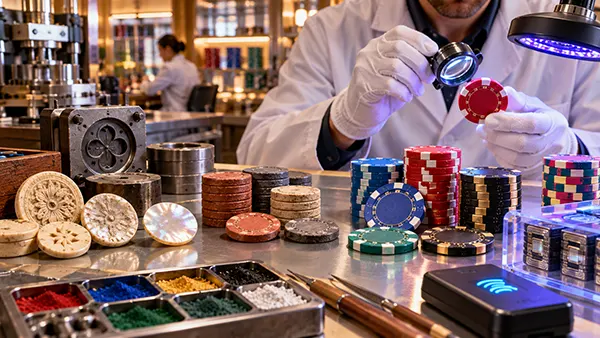
RFID and the Modern Layered Security Model
Radio-frequency identification added a new type of identity to the casino chip: information that a reader can detect electronically. RFID casino currency has been commercially available for many years, and manufacturers developed chips, plaques and jetons with embedded tags alongside readers designed for tables, cashier areas, chip trays, banks and vaults. The basic idea is straightforward. The physical chip contains an RFID component with identifying data. A compatible reader obtains that information and compares it with records used by the casino. The chip no longer has to be judged only by colour, weight and artwork. Its electronic identity can become another answer to the question, “Is this the item that it claims to be?” This is particularly valuable for high-value currency and large inventories, where manually checking every individual chip would be slow. RFID did not make traditional design features obsolete. Instead, it was added to them, creating an electronic check alongside the visual and physical characteristics that dealers and cashiers already understood.
RFID is sometimes described as if every tagged chip were a miniature tracking beacon, but that is misleading. Casino RFID normally works when chips come within range of suitable readers installed in places where currency is handled. Depending on the equipment, readers may be used at a table, within a chip tray, at the cage or in other controlled areas. The system can then identify or count compatible chips far faster than an employee checking them individually. This can help confirm inventory, detect an unexpected identifier and compare recorded amounts with the chips physically present. It can also reduce counting errors during routine operations. The security advantage lies in matching an object to data already known by the casino. A counterfeit that reproduces the visible artwork but lacks an acceptable RFID identity can fail an electronic check. At the same time, an operator still needs proper database management, trained staff and physical controls. RFID strengthens the chain of authentication; it does not replace the rest of that chain.
RFID remains an active part of casino technology in 2026 rather than a historical experiment. Angel Group, which acquired Gaming Partners International in 2019, continues to list casino chips and plaques with RFID security features as part of its current product range. Its Smart Float equipment is designed to determine the authenticity of compatible chips at a table while reading their amount and quantity. The scale of recent deployments shows how electronic chip identification can be incorporated into normal casino operations. In February 2025, Angel Group reported completion of its Smart Table implementation across more than 1,100 mass-market baccarat tables operated by Sands China in Macao and stated that roughly 2,000 baccarat tables across Macao, Singapore, the Philippines and Australia were then using its Smart Table system. In that setup, RFID works together with other forms of data capture to record information such as chip quantity, type and table location. The significance is practical: electronic identification has moved from protecting an individual high-value chip to supporting broader table management and reconciliation.
What Casino Chip Security Looks Like in 2026
By 2026, there is no single feature that defines a secure casino chip. The strongest approach is layered. A chip begins with a casino-specific visual identity that helps staff recognise it quickly. Its dimensions, construction and edge design provide further physical reference points. Covert markings or specialised printing can support closer examination. Individual identifiers and RFID can add database-based authentication. Around the chip sit operational controls: secure manufacturing, documented inventories, surveillance, cashier procedures and rules governing redemption. This matters because different threats require different responses. A poor visual counterfeit might be stopped by a dealer. A better copy might be detected when hidden features are checked. An item with convincing artwork may still fail an RFID or inventory check. A genuine chip presented in suspicious circumstances can prompt questions about how it was obtained. Effective anti-counterfeit security is therefore less about finding one perfect technology and more about making an attacker defeat several independent controls without creating an inconsistency elsewhere.
The value of redemption controls became particularly clear after the widely reported Bellagio robbery in Las Vegas in December 2010. An armed robber took casino chips with a face value of about $1.5 million, including pieces worth up to $25,000. Yet stolen chips were not equivalent to taking the same amount in ordinary cash because high-value casino currency had to return to the issuing property to be redeemed. Bellagio subsequently announced that its existing $25,000 chips would be discontinued and set a period during which legitimate holders could exchange them. The case is sometimes retold primarily as an RFID story, but contemporary reporting focused strongly on the more fundamental safeguard: the operator controlled redemption and could retire a chip series. That distinction remains useful today. Electronic identification can strengthen control, but the issuing casino’s ability to recognise, monitor, replace and ultimately refuse discontinued currency is itself a powerful defence. Current Nevada rules continue to require formal redemption plans when approved chips are permanently removed or replaced.
The path from carved bone and ivory to RFID shows that casino chips evolved in response to the same recurring challenge: they have to be convenient enough to circulate quickly but controlled enough to represent substantial value safely. Early counters solved the problem of counting. Standardised composition chips made commercial games easier to operate. Property-specific artwork and moulds made substitution more difficult. Hidden markings, regulated production and serialisation created additional barriers. RFID then connected individual pieces to electronic records and automated readers. Yet older methods did not simply disappear each time a new one arrived. A modern chip still relies on recognisable colours, a clear denomination, physical construction and trained human inspection alongside newer electronic checks. That continuity explains why physical casino chips remain useful even as cashless wagering expands. Their history is not a straight replacement of one material by another; it is a gradual accumulation of safeguards, turning a simple gaming counter into a controlled item whose appearance, manufacture, circulation and redemption can all be checked.