
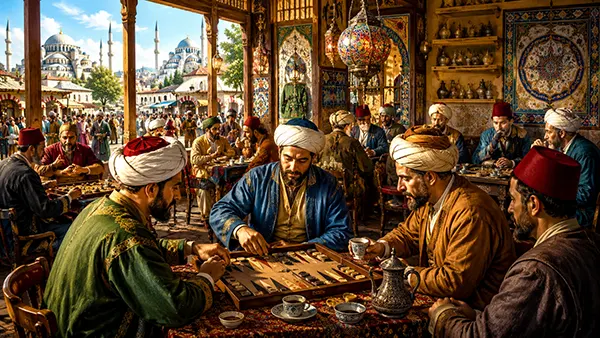
Gambling occupied an unusual place in the history of the Ottoman Empire. Islamic law generally prohibited games involving wagers, yet many forms of gambling continued to exist throughout the empire for centuries. Imperial authorities repeatedly attempted to suppress these activities, particularly in major cities such as Constantinople, Bursa and Edirne, but complete enforcement proved impossible. Coffeehouses, markets, caravanserais and private homes became places where people gathered not only for conversation and music but also for games involving money or valuable goods. The history of Ottoman gambling therefore reflects the constant balance between religious principles, state regulation and everyday social life.
Religious Law and Imperial Attempts to Restrict Gambling
Islamic teachings classified gambling, known as maysir or qimar, as a prohibited activity because it involved acquiring wealth through chance rather than labour or trade. Ottoman legal scholars consistently referred to Quranic guidance when issuing opinions against wagering, and judges were expected to uphold these principles within their jurisdictions.
Successive sultans introduced decrees aimed at limiting gambling. These measures often appeared alongside regulations concerning alcohol consumption, public disorder and moral conduct. During periods of political instability or economic hardship, restrictions became stricter, with local officials instructed to inspect coffeehouses and other gathering places where betting was suspected.
Despite these official policies, enforcement varied greatly across the empire. Large urban centres presented particular challenges because of their dense populations and active commercial life. Provincial governors frequently focused their attention on maintaining public order rather than eliminating every instance of gambling, allowing many informal activities to continue when they did not create significant disturbances.
Court Records and Historical Evidence of Gambling Cases
Ottoman court registers, known as kadı sicilleri, provide valuable evidence of gambling-related disputes. Rather than describing organised gambling businesses, these documents commonly mention disagreements over unpaid wagers, confiscated possessions or conflicts arising from games played in neighbourhood settings.
Imperial archives also contain correspondence between provincial administrators and the central government discussing illegal entertainment venues. These records demonstrate that authorities remained aware of recurring gambling activities even after repeated campaigns against them, highlighting the practical limits of state control.
European diplomats, merchants and travellers visiting the Ottoman Empire from the sixteenth to the nineteenth centuries left detailed observations describing public life. Although their accounts should be interpreted carefully because of cultural bias, many independently noted that games involving wagers continued to appear despite official prohibitions, supporting evidence preserved in Ottoman administrative documents.
Coffeehouses as Centres of Social Life and Informal Gaming
The first Ottoman coffeehouses emerged during the sixteenth century and quickly became important meeting places throughout the empire. Visitors gathered to discuss politics, literature, trade, religion and current events while enjoying coffee, tobacco and various forms of entertainment. These establishments attracted merchants, craftsmen, scholars, soldiers and travellers from many backgrounds.
Games formed a regular part of coffeehouse culture. Chess and backgammon were among the most popular activities because they combined strategy with social interaction. Although these games were often played purely for enjoyment, some participants privately agreed to wager coins, food, clothing or other valuable possessions, creating gambling opportunities outside official supervision.
Authorities frequently viewed coffeehouses with suspicion because they encouraged large public gatherings. Beyond concerns about gambling, officials worried that these venues could spread political criticism or facilitate unrest. As a result, temporary closures and inspections became common during different periods of Ottoman history, particularly under rulers seeking tighter control over urban society.
Popular Games Played Across Ottoman Society
Backgammon, known locally as tavla, remained one of the empire’s most widespread board games. Its combination of strategic decisions and dice rolls made it attractive to players from many social classes. Friendly competitions often took place without wagers, although historical sources indicate that betting was never entirely absent.
Dice games required little equipment and could easily be organised in markets, inns or private homes. Because the outcome depended heavily on chance, religious authorities criticised these games more strongly than contests based mainly on skill. Nevertheless, they remained common among soldiers, travelling merchants and urban workers.
Card games became more visible during the later centuries of the Ottoman Empire as contact with European merchants increased. Although cards never displaced traditional board games, they gradually appeared in cosmopolitan cities connected to Mediterranean trade, adding another form of wagering to existing recreational activities.
Festivals, Public Celebrations and Traditional Games
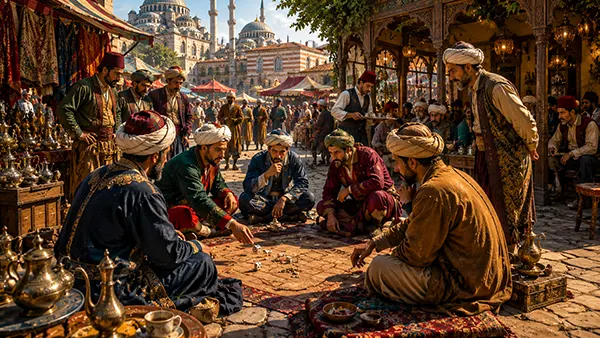
Public festivals occupied an important place in Ottoman society and offered opportunities for a wide variety of recreational activities. Religious holidays, military celebrations, royal weddings and circumcision festivals organised for members of the imperial family attracted enormous crowds. These occasions featured musicians, storytellers, wrestlers, acrobats and travelling entertainers who transformed city squares into lively centres of celebration.
Most festival games rewarded participants with food, clothing, household goods or symbolic prizes rather than cash. Archery contests, wrestling tournaments and equestrian competitions reflected skills valued by Ottoman culture and military tradition. These events encouraged competition while remaining socially acceptable because success depended largely on ability rather than chance.
Alongside these organised activities, informal betting frequently appeared among spectators. People placed small wagers on wrestling matches, horse races, athletic contests or animal competitions. Such betting was difficult for officials to regulate because it occurred privately between individuals instead of through organised establishments.
How Gambling Survived Despite Official Restrictions
One reason gambling persisted throughout the Ottoman period was its close connection with everyday social interaction. Friends gathering after work, merchants resting during long journeys and neighbours meeting in local coffeehouses often regarded small wagers as part of friendly competition rather than serious violations of religious law. This distinction helped gambling remain embedded within ordinary life.
Economic circumstances also played a role. During difficult periods, some individuals viewed games of chance as an opportunity to improve their financial situation quickly, despite the risks involved. Historical sources show that authorities were especially concerned when gambling contributed to debt, family disputes or criminal behaviour rather than occasional low-value wagers.
The empire’s enormous geographical size further complicated enforcement. From the Balkans and Anatolia to the Arab provinces and North Africa, local customs varied considerably. Provincial officials exercised significant discretion, resulting in different levels of tolerance depending on regional traditions, local leadership and broader political conditions. This diversity meant that gambling practices never disappeared entirely, even when imperial decrees called for stricter enforcement.