
I. Introduction
Playing cards are an integral part of civilization. They are used for a variety of purposes including games, divination and magic. In this article, we will look at the history, types and meaning of playing cards.
II. History of playing cards
The origin of playing cards is still shrouded in mystery, but most historians believe they originated in China during the Tang Dynasty (618-907 AD). From there they spread to Persia and the Islamic world, and at the end of the 14th century they came to Europe. At first, playing cards were used for various games and were a popular entertainment among both the rich and the common people. Over time, playing cards have evolved and changed to reflect the cultural, social and political conditions of the various regions.
III. Samples of European, American and Tarot cards
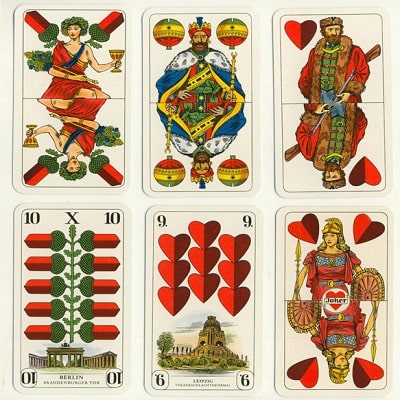
- European playing cards developed several regional suit systems rather than only two. Latin-suited packs, still used in parts of Italy, Spain and other regions, traditionally feature cups, coins, swords and batons or clubs. German-suited packs use hearts, bells, acorns and leaves, while Swiss-German cards have their own related symbols. The now internationally familiar hearts, diamonds, clubs and spades belong to the French suit system, which became established during the fifteenth century. Different European traditions also vary in deck size and in the design and ranking of court cards, so the standard 52-card pack represents only one branch of a much broader card-making tradition.
- Most American-style playing cards belong to the French-suited tradition that reached North America through English card designs. A typical modern pack contains 52 cards divided among clubs, diamonds, hearts and spades, with a king, queen and jack in each suit; many commercial packs also include two Jokers, although they are not required in every game. American card makers also helped popularise practical features such as corner indices, which allow players to identify cards while holding them in a compact fan. Double-ended court figures serve a similar purpose because a card does not need to be turned around to view its character correctly. This familiar format is used not only for bridge and poker but also for a wide range of other card games.
- Tarot cards form a distinct historical branch of European playing cards. The earliest documented references to tarot date from the 1440s and 1450s in Italy, where the cards were used for trick-taking games rather than being created specifically for fortune telling. A traditional tarot pack contains 56 suit cards together with 21 trump cards and the Fool, making 78 cards in total. In later occult traditions, these groups became commonly known as the 56-card Minor Arcana and the 22-card Major Arcana. The strong association between tarot and divination developed centuries after the earliest tarot games and became especially prominent during the nineteenth century. Tarot therefore has both a long-standing gaming tradition and a separate, later history connected with symbolic and divinatory practices.
IV. The meaning of playing cards
Playing cards have played an important role in the culture and history of mankind. They were used for games, divination, and also as a symbol of power and wealth. In some cultures, playing cards were used to pass the time, while in others they were used to make political or religious statements. Today, playing cards are an integral part of popular culture, and they are still used for games, magic, and divination.
V. Conclusion
In conclusion, playing cards have been an integral part of human civilization for hundreds of years. They have gone through many changes and variations, each reflecting the culture and beliefs of their time. Whether used for games, divination, magic, or as a symbol of power and wealth, playing cards continue to be an important part of human culture and history.