
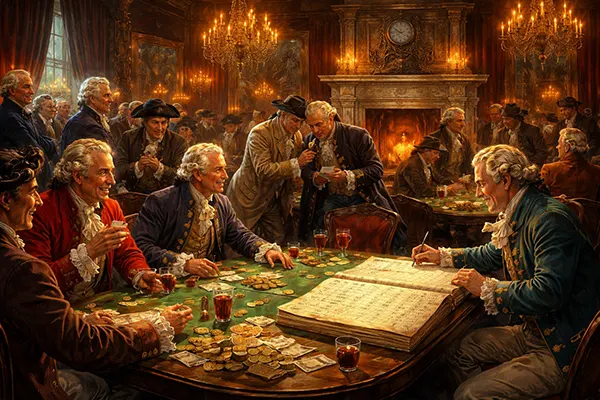
In 18th-century London, gambling was not confined to dice or cards. Elite clubs such as White’s became centres where wagers reflected social life itself. Members recorded bets in ledgers, staking money on political outcomes, weather patterns and even personal reputation. These practices reveal a culture where risk-taking extended far beyond gaming tables and became part of daily aristocratic identity.
White’s and the Rise of Exclusive Betting Culture
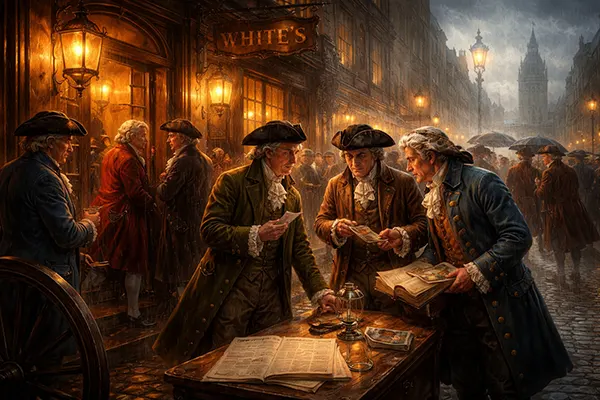
White’s, founded in the late 17th century and flourishing throughout the 18th, stood as one of London’s most influential gentlemen’s clubs. It attracted aristocrats, politicians and wealthy patrons who shaped both society and public opinion. Gambling was a central activity, but it operated within a structured and socially regulated environment.
Unlike public gaming houses, White’s maintained exclusivity. Entry was limited, and reputation mattered as much as wealth. Members trusted each other’s honour, which allowed wagers to extend beyond immediate outcomes. Debts were often settled informally, relying on personal credibility rather than legal enforcement.
The club’s significance went beyond entertainment. It functioned as a meeting point where politics, finance and leisure overlapped. Decisions discussed within its walls could influence national affairs, making its betting culture a reflection of broader societal dynamics.
The Betting Book as a Social Record
One of the most distinctive features of White’s was its betting book. This ledger recorded wagers made by members, often in precise and sometimes humorous language. Entries ranged from simple bets on card games to complex predictions about public events.
The betting book served not only as a financial record but also as a snapshot of contemporary interests. Members wagered on elections, military campaigns and even the lifespan of prominent figures. These entries provide historians with valuable insights into the concerns and attitudes of the British elite.
Importantly, the existence of such a record reinforced accountability. While bets could be informal, once written in the book they carried weight. This system balanced freedom with structure, allowing creativity in wagering while maintaining order within the club.
Wagering Beyond Games: Politics, Weather and Reputation
By the 18th century, betting had expanded into areas that might seem unusual today. At White’s and similar clubs, members placed wagers on political developments, including the outcomes of parliamentary votes or the stability of governments. These bets reflected both interest and insider knowledge.
Weather betting was another common practice. Members speculated on snowfall, rainfall or temperature changes, often linking wagers to specific dates. Such bets highlight how gambling intersected with everyday uncertainty, turning natural events into opportunities for risk and reward.
Perhaps the most striking aspect was betting on reputation and personal behaviour. Wagers could involve predictions about marriages, scandals or social standing. These bets blurred the line between entertainment and social commentary, reinforcing the importance of honour within elite circles.
Risk, Information and Influence
The expansion of betting topics was closely tied to access to information. Members of clubs like White’s often had privileged knowledge, whether political or social. This created an environment where betting could be informed rather than purely speculative.
At the same time, the act of placing a wager could influence behaviour. Public bets on political outcomes or personal actions added pressure on individuals involved. In some cases, betting itself became part of the narrative, shaping expectations and discussions.
This interplay between information and risk demonstrates how gambling functioned as more than leisure. It acted as a mechanism for expressing opinions, testing predictions and engaging with the uncertainties of the time.
Legacy of 18th-Century Betting Practices
The traditions established in clubs like White’s left a lasting imprint on British gambling culture. The idea of structured wagering, recorded agreements and socially enforced debts can be seen in later developments of betting systems and bookmakers.
Modern betting markets, particularly those related to politics or entertainment, echo these historical practices. While today’s systems rely on technology and regulation, the underlying concept of wagering on real-world events has clear roots in 18th-century club culture.
Furthermore, the emphasis on reputation and trust remains relevant. Even in regulated environments, credibility and transparency are essential. The informal honour system of White’s has evolved, but its principles continue to influence how betting is perceived and managed.
From Private Clubs to Public Markets
Over time, betting moved beyond exclusive clubs into broader society. The development of public betting houses and later regulated bookmakers made wagering accessible to a wider audience. This shift transformed gambling from an elite pastime into a mainstream activity.
Despite this expansion, the intellectual aspect of betting persisted. Predicting outcomes, analysing information and weighing risk remain central to the experience. These elements connect modern practices with their historical origins.
The story of White’s and similar clubs illustrates how gambling can reflect the values and concerns of a particular era. In 18th-century London, betting was not merely about chance but about understanding and engaging with the world.