
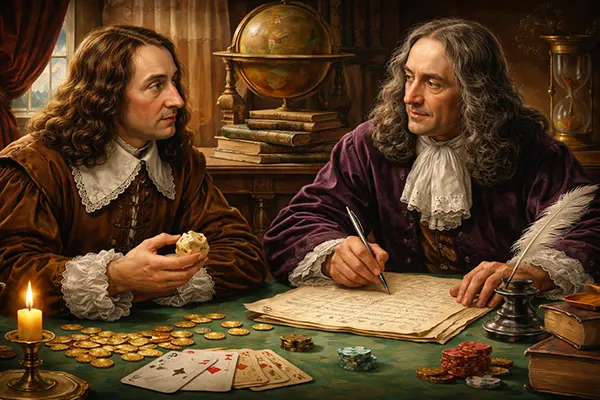
Probability did not start as an abstract school topic. It started as an argument about money. In the 1650s, players in France faced a practical question: if a match is interrupted, how do you split the stake without cheating either side? That single headache—shared by gamblers, nobles, and mathematicians—pulled Blaise Pascal and Pierre de Fermat into a short, intense correspondence that still reads like a blueprint for modern risk thinking.
The “Problem of Points” in plain terms
The classic set-up is simple. Two players agree to play a series where the first to win a fixed number of rounds takes the entire stake. Then the match stops early—someone has to leave, a quarrel breaks out, or the venue closes. The question is not “who was ahead?”, but “what is each player’s fair share of the stake given what could still happen next?” That question became known as the Problem of Points, and it sits right at the origin of probability as a method.
Here’s a concrete example you can do on paper. Suppose the target is 5 wins, the stake is £100, and the score is 3–2. Player A needs 2 more wins; Player B needs 3. The game is stopped. One tempting method is “split by current score” (A gets £60, B gets £40). Pascal and Fermat argued for a stricter standard: split by the chances of each player winning if the match continued under the same rules. That turns “fairness” into a counting problem.
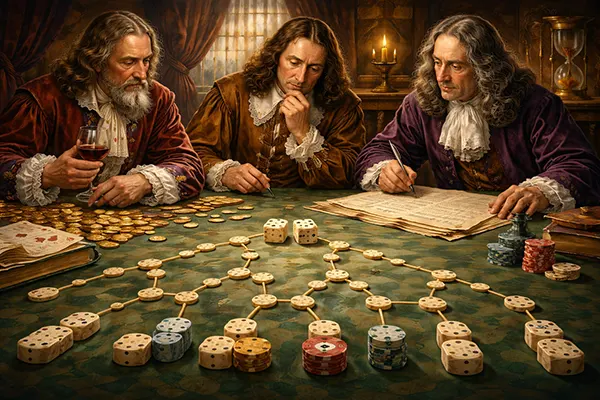
To count those chances, you don’t need modern formulas. Imagine the next few rounds as a tree of possible outcomes. In a race-to-5 from 3–2, the match can finish within at most 4 further rounds. You count the sequences where B manages to reach 5 before A does. When you enumerate the paths, A’s chance is higher than 60%—so A’s fair share is more than £60. The key step is not the exact percentage; it’s the rule: pay out in proportion to what the future was worth, not just what already happened.
Why the de Méré-style gambling questions mattered
Pascal did not decide to invent probability for its own sake. The correspondence was sparked by gambling questions circulating in Parisian circles—questions that tested whether popular “systems” were actually fair. When these arguments reached Pascal, he took them seriously enough to ask Fermat for a clean mathematical treatment. That social detail matters: the maths emerged because the stakes were real and reputations were on the line.
Those gambling questions also forced clarity about assumptions. Are rounds independent? Is each player equally skilled? Are the chances constant from round to round? Once you write those assumptions down, you can see exactly what you are paying for. If the players are not equally matched, the “fair” split changes. This is already the logic of modern modelling: your answer is only as strong as the structure you assume.
One lasting payoff of the Pascal–Fermat approach is that it teaches discipline about uncertainty. You do not need certainty to be fair; you need a method that treats both sides symmetrically and prices the remaining possibilities. That is why the Problem of Points is still taught today: it is the cleanest doorway into expected value thinking.
When “fair play” becomes the mathematics of risk
Once you accept “split the stake by the chance of winning,” you accept a much bigger idea: uncertain outcomes can be valued. In modern language, you are assigning a price to a set of possibilities. This is the bridge from moral intuition (“be fair”) to calculation (“what is the fair amount?”). That bridge is exactly what later probability theory formalised.
The natural next step is expected value: the average payout you would get if you could repeat the same situation many times. This idea is central to how probability moved from private letters into printed mathematics. It also explains why gambling problems were so productive: they are small, rule-based worlds where you can test reasoning without messy real-life noise.
Notice what changes psychologically. Before, players argued from gut feeling and anecdotes: “It feels like I’m due a win.” After the Pascal–Fermat style of reasoning, the conversation shifts: “What are the possible futures, and how many of them favour me?” This is the moment where risk becomes something you can discuss without superstition. It does not make the world predictable; it makes decisions explainable.
From counting outcomes to building tools people actually use
Counting outcomes sounds harmless until you realise what it enables. Once you can calculate the value of an uncertain position, you can compare choices. Should you accept a cash-out offer? Should you insure a shipment? Should you take a sure smaller payout or keep the risk for a bigger one? These are the same structure: trade uncertainty for a defined outcome on terms you can justify.
That is also why early probability thinkers kept returning to games. Games are controlled laboratories. Dice, cards, and interrupted matches have clear rules and repeatable structure. If you cannot reason well there, you will not reason well in the real world. In that sense, gambling did more than “inspire” probability—it provided a testing ground where wrong reasoning gets punished immediately.
By the early 1700s, the field was no longer just a clever method shared between a few mathematicians. Probability became a general language for reasoning under uncertainty, used to discuss risks, evidence, and long-run patterns. The arc is clear: disputes about stakes became a theory with applications far beyond the gaming table.
Why this reshaped insurance, finance, and lotteries
The most direct non-gambling beneficiary was insurance. Insurance is a promise about uncertain loss, priced so the promise can be kept. You cannot price that promise without some method for turning uncertain futures into numbers. Probability supplies the grammar: frequencies, averages, and ranges of outcomes, even when any single event remains unpredictable.
Public record-keeping also pushed this shift forward. Once deaths, births, accidents, and claims are recorded over years, you can see patterns without pretending to predict individual lives. That data-first mindset is a key step toward modern actuarial work: not prophecy, but structured estimation based on evidence and careful assumptions.
State finance followed the same logic. When governments sell long-term products—annuities, pensions, debt—they are effectively negotiating uncertainty over time. Probability-informed thinking helps separate political promises from calculable commitments, and it makes pricing more transparent, even when the uncertainty cannot be removed.
What this means in practice in 2026
By 2026, the descendants of those ideas are everywhere. Insurers model claim frequency and severity; banks stress-test portfolios under adverse scenarios; sports and gaming operators publish rules and payout structures that can be analysed in plain expected-value terms. The calculations can be sophisticated, but the skeleton is still the Pascal–Fermat mindset: list outcomes, assign chances, value positions, and keep the rule transparent enough to defend.
Modern risk work also adds humility. Real life is not a fair coin. Models can be wrong, correlations can break, and rare events can dominate outcomes. That is why serious risk teams combine probability with governance: model validation, sensitivity checks, scenario analysis, and clear limits on what a calculation is allowed to claim.
For ordinary players and consumers, the practical lesson is simple: “fair” is not the same as “favourable.” A game can be fair in rules and still be a poor deal once you account for payout structure or house edge. Probability’s gambling roots are not just history—they are a reminder to separate excitement from arithmetic, and to treat uncertain decisions as choices you can justify, not stories you tell yourself.