
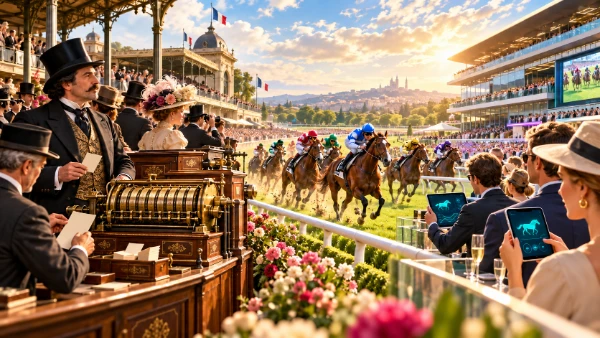
Pari-mutuel betting has shaped horse-racing wagering for more than 150 years, yet its basic idea remains strikingly simple. Instead of accepting a price set by a bookmaker, bettors put their stakes into a common pool. After the relevant deductions have been made, the remaining money is divided among those holding winning bets. The final return therefore depends not only on the result of the race but also on how the rest of the betting public has distributed its money. This system grew from the experiments of nineteenth-century entrepreneur Joseph Oller in France and eventually became the basis for national racing organisations, mechanical totalisators, computerised pools and today’s internationally combined World Pool bets. Its history is closely connected with changing attitudes towards racing, regulation and the question of how betting revenue should be shared.
Joseph Oller and the Birth of Pari-Mutuel Betting in France
Joseph Oller was born in Terrassa, Catalonia, in 1839 and moved to France with his family while still a child. He later became associated with two seemingly different sides of Parisian life: horse racing and popular entertainment. Long before his involvement with venues such as the Moulin Rouge and Olympia made him famous as a show-business entrepreneur, Oller had taken an interest in betting. French racing was expanding during the middle of the nineteenth century, attracting wealthy owners, regular racegoers and an increasingly organised betting trade. Bookmakers generally offered odds directly to customers, meaning that the bookmaker accepted both the stake and the financial risk attached to the quoted price.
Oller began experimenting with another approach during the 1860s. The French Ministry of Culture’s equestrian heritage resource places his early work on mutual betting in the middle of that decade. He operated betting agencies and used mobile facilities that could follow race meetings. Earlier pool arrangements could resemble a lottery: participants bought tickets and the eventual allocation of a horse might depend on a draw. Oller gradually moved away from that method. By 1867, the form generally recognised as pari-mutuel betting allowed customers to choose the horse themselves while their stakes were combined with those of other bettors making the same type of wager.
The French expression pari mutuel can be understood as a “mutual bet”, and that description captures the crucial difference from conventional bookmaking. Oller did not need to promise a fixed price for every runner before knowing the final balance of bets. Losing stakes helped finance payments to the winners, while the operator retained a deduction. If a large proportion of the pool had backed the winning horse, each successful unit received a comparatively modest return. If relatively little money had supported the winner, the dividend could be much larger. The crowd therefore helped determine the eventual price through its collective betting behaviour.
Why the Totalisator Became Essential
The concept was straightforward, but administering it was not. An operator had to know how much had been staked in total and how much money had been placed on every horse before an accurate dividend could be calculated. As the number of customers increased, handwritten records became slow and vulnerable to mistakes. Oller responded by developing a mechanical counting system. In 1868 he patented a totalising counter designed to record individual betting amounts and combine them into an overall total. Contemporary descriptions of the device show separate counters for runners together with a general figure representing the complete betting pool.
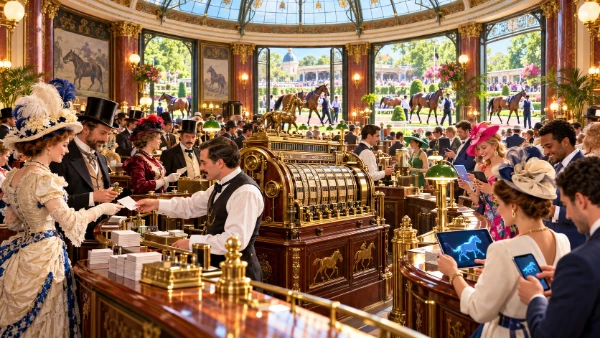
This connection between pari-mutuel betting and the totalisator proved extremely important. A totalisator did not choose the winner or decide how a horse should be priced. Its job was to record and total the bets so that the distribution of money could be seen and the eventual return calculated. Later generations of machinery performed the same task much faster. Mechanical equipment gave way to electrical systems and eventually to computers, but the purpose remained recognisable: collect stakes, keep an accurate account of the pool and calculate the amount due to winning units after deductions.
French law did not immediately provide a settled environment for Oller’s business. Betting and lottery-style schemes were subject to repeated legal disputes during the nineteenth century. The decisive change came in 1891, when legislation authorised pari-mutuel betting on French racecourses under regulated conditions. The model subsequently became deeply embedded in French racing. In 1930, the creation of the Pari Mutuel Urbain, better known as the PMU, extended organised pool betting beyond the racecourse. By then, the principle first developed in Oller’s era had become far more than an individual business idea: it was an established method of financing regulated racing.
How the Totalisator Reached Britain and Created the Tote
Britain followed a different path. Bookmakers had long been central to British racing, and fixed-odds betting remained an important part of the sport. During the 1920s, however, Parliament considered whether a regulated totalisator could provide an additional betting method while directing money back towards racing. The Racecourse Betting Act 1928 created the Racecourse Betting Control Board and provided the legal framework for totalisator betting at approved racecourses. Winston Churchill was Chancellor of the Exchequer when the measure was introduced. The organisation created under this system would become widely known simply as the Tote.
The first British racecourses to use totalisators under the new arrangements were Newmarket and Carlisle on 2 July 1929. Unlike a bookmaker quoting, for example, a price of 4/1 and accepting the liability if the horse won, the totalisator combined the money staked by its customers. Once the pool closed and the race result was known, deductions were made and the remaining sum was divided among winning bets. This distinction remains central to understanding Tote betting. A displayed pool price can move as more money arrives because it reflects the balance of the pool rather than a contractual fixed price agreed when the bet was placed.
The Tote acquired an unusually close relationship with British racing because it had been created by statute rather than established as an ordinary private bookmaker. Its purpose included providing regulated pool betting and returning financial benefit to the sport. Over subsequent decades its reach extended beyond racecourse windows as betting habits and legislation changed. Computer systems replaced much of the older mechanical equipment, while more sophisticated bet types appeared alongside straightforward Win and Place pools. The name “Tote”, originally derived from totalisator, consequently became much better known than the full technical term from which it came.
From a Public Body to Modern Commercial Ownership
The ownership structure eventually changed substantially. Legislation passed in 2004 prepared the way for the historic Tote organisation to be transferred and sold. In 2011, the British government agreed the sale of the Tote to Betfred for £265 million. The transaction included a seven-year exclusive licence for pool betting on British horse racing. That exclusivity lasted until 12 July 2018. From 13 July 2018, operators holding the appropriate pool betting licence could also offer pool betting on British horse racing, removing the historic legal exclusivity that had distinguished the Tote for decades.
Another major change followed in October 2019, when UK Tote Group completed its acquisition of the Tote from Betfred. UK Tote Group was formed with investment from people connected with racing, including owners and breeders. The change returned the business to an ownership group whose stated focus included both developing pool betting and supporting the racing industry. The Tote therefore entered the 2020s as a privately owned betting business, but one carrying a name, betting method and relationship with British racing that can be traced directly to the legislation of the late 1920s.
The modern Tote offers far more than the basic single-race pools familiar to early twentieth-century bettors. Win and Place remain the simplest forms, while Exacta requires the first two horses in the correct order and Trifecta extends the requirement to the first three. Other pools cover several races. The Placepot, for example, normally asks customers to select a placed horse across nominated races at the same meeting. Despite these different formats, the underlying rule has not changed: stakes belonging to the same pool are combined, deductions are taken and successful betting units share what remains.
Why Pari-Mutuel Betting Still Matters in 2026
The most significant modern development is not a change to Oller’s fundamental principle but an enormous increase in the number of people whose bets can be combined. Digital connections allow separate racing jurisdictions to commingle stakes into the same pool. Instead of a pool being limited to spectators at one racecourse, money can arrive through licensed operators in several countries. A larger pool generally provides greater liquidity and allows substantial bets to be absorbed with less effect than they might have in a small local pool. International commingling has therefore given a nineteenth-century betting model a new role in twenty-first-century racing.
World Pool is the clearest example. Created by the Hong Kong Jockey Club, it combines eligible bets from participating racing markets into international pools on selected meetings. During 2026 its schedule covered major racing in numerous jurisdictions, including Britain, Ireland, Hong Kong, Australia, South Africa, New Zealand, Germany and the United Arab Emirates. Royal Ascot was particularly notable: all 35 races across the five-day 2026 meeting were included in World Pool. The principle behind these international pools would still have been familiar to Oller — many bettors contribute to one pot and successful units receive a calculated share — but the geographical scale is entirely different.
The model has also become increasingly important to the Tote’s own direction. On 6 October 2026, UK Tote Group announced a strategic refocus towards British and international horse-racing pools, highlighting the growth of World Pool and its work with organisations including the Hong Kong Jockey Club, the British Horseracing Authority and Horseracing Ireland. The announcement is significant because it places pool betting, rather than treating it as merely a historic product, at the centre of the Tote’s future plans. Nearly a century after the British Tote was created, the original totalisator concept is still influencing how the business intends to develop.
What Has Changed — and What Has Stayed the Same
For a modern bettor, the most visible change is speed. Oller’s operation needed physical tickets and mechanical counting equipment; today’s pools can receive and process bets electronically from racecourses, betting shops, websites and connected operators. Indicative pool prices can be updated repeatedly before a race, and dividends can be calculated once betting has closed and the result is confirmed. Yet an important feature remains: the return is not necessarily known when the stake is placed. Money arriving later can change the proportion of the pool attached to each runner and therefore alter the eventual dividend.
This also explains why pari-mutuel and fixed-odds betting should not be treated as two names for the same thing. With a conventional fixed-odds wager, the bettor normally agrees a particular price with the bookmaker when the bet is accepted, subject to the operator’s rules. With a pool wager, participants effectively bet alongside one another, and the operator administers the pool and applies the relevant deductions. Britain’s Gambling Commission describes pool betting in these terms: stakes are combined and the amount received by successful customers is calculated from the total pool after commission. The operator’s role is therefore structurally different from that of a bookmaker taking the opposite side of an individual fixed-price bet.
More than 150 years after Joseph Oller developed his pari-mutuel method, its longevity comes from that simple structure. The equipment has moved from counters and ticket windows to real-time computer systems; British pool betting has moved from a statutory monopoly to a licensed market; and individual racecourse pools can now connect with bettors across continents. What has survived is the central idea established in nineteenth-century France: customers betting on the same outcome contribute to a common fund, and the successful participants share the distributable portion of that fund. The modern Tote and World Pool are therefore not replacements for Oller’s invention but large-scale descendants of it.