
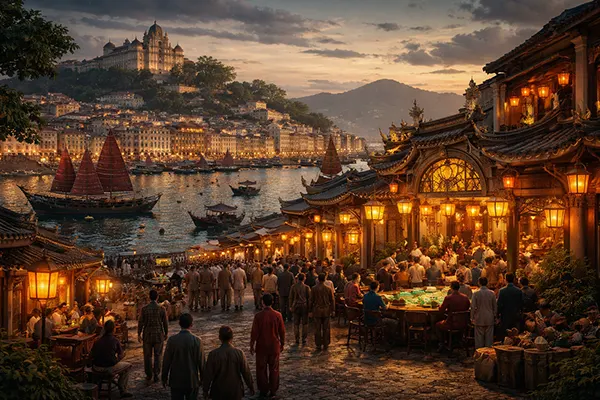
Long before the skyline of Cotai was filled with vast resort complexes, Macau had already established itself as a unique centre of regulated gambling in Asia. Its path was shaped not by rapid modern expansion, but by centuries of colonial governance, controlled licensing, and a distinctive relationship between local traditions and foreign administration. Understanding this earlier period reveals how Macau built a system that later allowed it to become one of the most influential gambling destinations in the world.
Colonial Foundations and the Birth of Regulated Gambling
Macau came under Portuguese administration in the mid-16th century, serving primarily as a trading post between Europe and China. Unlike many colonial territories, it developed a semi-autonomous system where local customs coexisted with European governance. Gambling was not introduced by the Portuguese themselves; it already existed in Chinese society, particularly through games like fan-tan, which became central to Macau’s early gambling identity.
By the 19th century, the colonial government recognised gambling as a potential source of stable revenue. Instead of banning it, authorities chose to regulate and tax it. This decision marked a turning point: gambling became institutionalised, with official licences granted to operators. The system allowed the government to maintain control while benefiting financially, creating one of the earliest examples of state-regulated gambling in Asia.
The licensing model also shaped the city’s economic structure. Gambling houses were concentrated in specific districts, often operating under strict supervision. This approach limited disorder while ensuring a steady income stream for the administration. By the late 1800s, Macau had already gained a reputation as a destination where gambling was both accessible and legally organised.
Fan-Tan Houses and Early Gambling Culture
Fan-tan was the dominant game in early Macau, played in dedicated houses that attracted both local players and visitors from mainland China. These establishments were simple compared to modern casinos, yet they formed the backbone of Macau’s gambling economy. The game’s structure—based on counting objects and betting on outcomes—was easy to understand and required minimal equipment.
The atmosphere in these houses reflected a mix of Chinese tradition and colonial oversight. Operators were required to follow rules imposed by Portuguese authorities, including licensing fees and operational limits. Despite these controls, the environment remained lively and deeply rooted in local culture, with gambling seen as both entertainment and social activity.
Importantly, these early venues established patterns that would persist for decades. The idea of concentrated gambling districts, regulated operations, and strong ties to mainland clientele all originated during this period. These elements later influenced the development of larger, more formal casino structures.
The Rise of Monopoly Concessions and Structured Growth
In the 20th century, Macau’s gambling industry underwent a significant transformation with the introduction of monopoly concessions. Rather than issuing multiple licences, the government granted exclusive rights to a single operator or consortium. This approach simplified regulation and ensured consistent revenue through negotiated agreements.
One of the most notable concessions was awarded in 1937, giving a single entity control over casino operations. This model created a more organised industry, replacing fragmented gambling houses with larger, more structured venues. It also allowed for better infrastructure development, as concessionaires invested in facilities to attract more visitors.
The monopoly system remained in place for decades and became a defining feature of Macau’s gambling landscape. It encouraged long-term planning and stability, although it also limited competition. Nevertheless, the model proved effective in maintaining Macau’s position as a leading gambling destination in Asia.
Stanley Ho and the Modernisation Phase
A major shift occurred in 1962 when a new concession was granted to Sociedade de Turismo e Diversões de Macau (STDM), led by Stanley Ho. Under his leadership, the industry entered a phase of rapid modernisation. Traditional gambling houses were replaced with more sophisticated casinos that offered a wider range of games and improved facilities.
Stanley Ho’s approach combined business expansion with strategic partnerships. He invested in transportation links, including ferry services, making Macau more accessible to visitors from Hong Kong. This significantly increased tourist flow and reinforced the city’s reliance on gambling as its primary economic driver.
During this period, Macau also began to develop its reputation for VIP gaming. High-stakes players were given dedicated spaces, setting the stage for a system that would later evolve into the well-known VIP room structure. This marked a clear shift from local-focused gambling to an international and high-value market.
VIP Rooms and the Role of Junket Operators
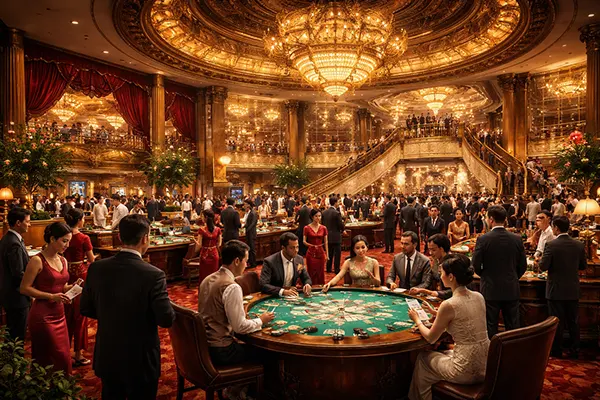
One of the most distinctive features of Macau’s pre-mega-casino era was the emergence of VIP rooms. These exclusive areas catered to wealthy players, particularly from mainland China, where gambling was prohibited. VIP rooms offered privacy, higher betting limits, and tailored services, making them central to the city’s gambling economy.
To support this system, junket operators played a crucial role. These intermediaries organised travel, provided credit, and facilitated the movement of funds. Their involvement allowed casinos to attract high-value clients while navigating legal and financial restrictions. In many cases, junkets managed entire VIP rooms within casinos.
This model created a unique ecosystem that differed from Western casino markets. Revenue became heavily dependent on high rollers rather than mass-market players. While this approach generated significant income, it also introduced risks related to credit management and regulatory oversight.
Transition Towards the Modern Macau Model
By the late 20th century, Macau had already built a complex gambling system combining colonial regulation, monopoly concessions, and VIP-focused operations. However, the limitations of the existing model became increasingly apparent. Infrastructure constraints and lack of competition restricted further growth.
The turning point came in 1999, when Macau was transferred from Portuguese to Chinese sovereignty as a Special Administrative Region. Shortly after, in 2002, the government ended the monopoly system and opened the market to international operators. This decision laid the groundwork for the large-scale developments seen today.
Despite these changes, many elements of the earlier era remained influential. The importance of VIP gaming, the role of intermediaries, and the tradition of regulated gambling all continued to shape Macau’s identity. The modern city did not emerge from scratch; it evolved from a system built over centuries of careful adaptation and control.