
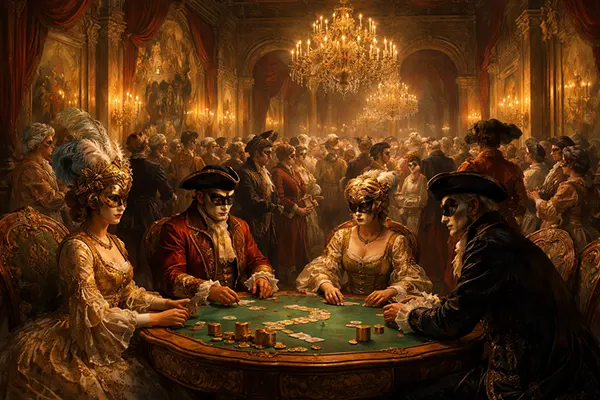
When people picture gambling in historic Venice, they often imagine masked aristocrats throwing fortunes across green tables during Carnival. That picture is not far off — but the most important detail is that Venice did not merely “allow” gambling. In practice, the Republic tried to manage it, channel it into controlled spaces, and profit from it. The most famous example was the Ridotto, widely recognised as Europe’s first state-sanctioned public gambling house, operating for more than a century and shaping what an organised casino could look like.
Why the Republic Legalised Gambling Instead of Banning It
By the early modern period, gambling in Venice was already deeply embedded in social life. Attempts to suppress it outright had limited success, especially during Carnival season, when visitors flooded the city and social rules loosened. The Venetian government faced a familiar problem: gambling did not disappear when prohibited, it simply moved into private rooms and informal venues where violence, cheating, and debt disputes were harder to police.
So the Republic pursued a pragmatic line that could be summed up as “control instead of prohibition”. In 1638, the state supported the creation of the Ridotto in the Palazzo Dandolo near San Moisè, effectively moving large-scale gambling into a supervised environment. This was not a charitable gesture. It was a calculated decision: monitoring was easier, social disorder could be reduced, and the city could extract revenue from behaviour it could not realistically eliminate.
By the 18th century, that approach had become part of Venice’s wider political logic. The Republic was built on regulation — of trade, of public morality, of public celebrations — and gambling was treated in the same way. The Ridotto became proof that a “vice” could be turned into a governed system, rather than a constant street-level problem.
Economic Incentives: Making Gambling Work for the City
The Ridotto was never only about entertainment. It was also about money. Venice was a trading power that understood how to turn human habits into fiscal advantage. By establishing a legal, organised gambling house, the Republic could keep profits within an accountable structure instead of letting private operators control the flow of money.
Just as importantly, a regulated venue allowed the authorities to track patterns of spending and debt. Gambling debts could destabilise noble families, and noble families were politically important. A state-recognised setting did not stop losses, but it reduced the chaos around them, and made enforcement of rules more predictable.
In other words, the Ridotto gave Venice an early version of something modern governments still debate: whether taxing and regulating a risky behaviour is more effective than chasing it into the shadows. That political reasoning — balancing revenue, public order, and reputation — explains why Venice invested in control rather than constant crackdowns.
The Ridotto: Rules, Atmosphere, and the “Public” Nature of the Casino
The Ridotto is often described as a glamorous gambling hall, but it was also a controlled environment shaped by strict entry expectations. It operated as a public venue in the sense that it was legal and open to paying visitors, yet it still reflected Venice’s obsession with order, hierarchy, and appearances. It was not a casual gaming room; it was a space where behaviour was framed by policy and ritual.
One of the best-known features was the requirement for masks and formal dress. Masking — particularly associated with Venetian social life — served several functions at once. It enabled anonymity, reduced open social conflict, and allowed interaction across class boundaries while still preserving a sense of theatre and discipline. Formal dress codes reinforced that the Ridotto was meant to look respectable, even while facilitating high-stakes wagering.
The Ridotto also enforced a structured setting for games, with defined spaces and a controlled environment that contrasted with unregulated gambling houses. That mattered because order was part of the brand of Venice itself. The city sold an image: refined, spectacular, safe enough for foreign elites to visit, spend, and return home with stories.
Games, Behaviour, and the Logic of Regulation
Although gambling culture was vibrant, the Ridotto’s organisation signalled that the state was present even in leisure. Venetian authorities had a long history of regulating public spaces: markets, theatres, festivals, and even clothing. Gambling fit naturally into this administrative mindset.
Regulation also reduced one of the biggest public risks: disorder among crowds. Unregulated gambling venues could turn into sites of brawls, intimidation, and disputes over cheating. A state-recognised venue, tied to a specific location and supervised through legal permission, made it easier to intervene before such problems spilled into the streets.
Over time, however, the Ridotto’s influence was challenged by the spread of smaller private “casini” and informal ridotti across the city. Even as the main venue remained symbolic, Venice faced growing concerns about financial ruin and moral panic. These pressures would eventually contribute to the Ridotto’s closure in 1774 by decision of the Great Council.
Social Classes at the Tables: Mixing, Boundaries, and Control
The Ridotto was unusual because it created a space where different social groups could circulate in proximity. Venice was rigidly stratified, yet it was also a city whose economy depended on outsiders — merchants, diplomats, wealthy travellers. Gambling offered one of the few environments where elite locals and affluent visitors could interact without the same constraints as formal politics.
Still, “mixing” did not mean equality. The Ridotto’s atmosphere, costs, and expectations made it easier for nobles and wealthy patrons to participate, while poorer Venetians were less able to sustain high-stakes play. In practice, the venue reinforced hierarchy even while appearing open. Those with money could remain in the game; those without it were quickly excluded by reality, if not by written rule.
Yet the symbolic effect mattered. A masked environment made status harder to read immediately, and that was both thrilling and politically risky. Venetian authorities tolerated it because it helped Carnival function as controlled release — a time when social tensions could be redirected into ritual rather than rebellion.
Taxation, Politics, and “Control Instead of Prohibition” as State Strategy
By the 18th century, Venice’s approach to gambling had become part of its wider governance strategy. The Republic did not pretend gambling was harmless. In fact, debates about moral decline and financial ruin were common, and political figures argued that the Ridotto had become a source of scandal rather than stability.
In 1774, reformer Giorgio Pisani proposed closing the Ridotto, and the motion passed decisively, shutting down the venue that had operated since 1638. The reasoning was explicitly tied to public discipline and the fear of citizens being ruined. That decision shows an important point: regulation was always conditional. Venice tolerated gambling when it served public order and revenue, but withdrew support when it appeared to undermine social stability.
Even so, the Ridotto’s legacy remained. It offered one of Europe’s earliest examples of a state managing gambling through licensing, rules, controlled access, and fiscal advantage. Modern debates about regulation versus prohibition mirror the same logic Venice tested centuries ago — with the same tension between public benefit, private loss, and political legitimacy.